


Ignore the generic advice you read on national websites. Living in Colorado means you play by a different set of rules for radon gas. I tell every single buyer that radon is not an "if" but a "when". It does not matter whether the home is brand new or 100 years old. Our dirt is different here and it changes everything about how we look at safe air.
The national average for homes with high radon levels is about 1 in 15. Here in El Paso County roughly half of all homes fail the test. If you think you are safe because you do not have a basement you are wrong.
The "Chest X-Ray" Comparison: Putting the Risk in Perspective
Because you can’t see, smell, or taste radon, it is easy to dismiss it as a minor "paperwork" issue during a home inspection. However, the EPA and the Surgeon General use a startling analogy to help homeowners visualize the long-term health impact of living in a high-radon environment.
In Colorado, the average indoor radon level is approximately 6.4 pCi/L. To put that in perspective:
- The Daily Equivalent: Breathing air at that level is equivalent to smoking about half a pack of cigarettes every single day.
- The Medical Equivalent: Over the course of a year, the radiation exposure from a 6.4 pCi/L home is roughly equal to receiving 300 chest X-rays.
Even if your home tests at the EPA "Action Level" of 4.0 pCi/L, you are still receiving the radiation equivalent of roughly 200 chest X-rays per year. While a single X-ray at the doctor’s office is a controlled medical tool, living in a home with elevated radon means your lungs are being exposed to that radiation 24 hours a day, 365 days a year.
Colorado Radon Disclosure Requirements: What the Law Mandates
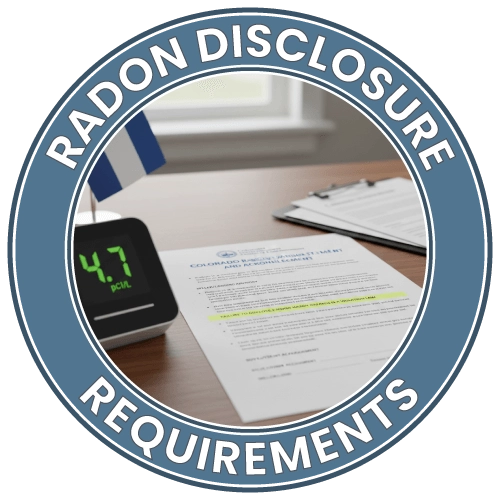 In August 2023, Colorado Senate Bill 23-206 went into effect, significantly changing the responsibilities for anyone selling or leasing a home in the state. Radon is no longer just a "recommendation"—it is a legal disclosure requirement.
1. For Home Sellers
If you are selling a home in Colorado, you are legally required to provide the buyer with the following before they sign a contract:
- Specific Warning Language: Every residential sales contract must now include a bolded, state-mandated warning statement regarding the risks of radon.
- Full Disclosure of Records: Sellers must provide copies of all previous radon test results and reports, as well as documentation for any mitigation systems already installed.
- Educational Brochure: You must provide the buyer with the most recent radon brochure published by the Colorado Department of Public Health and Environment (CDPHE).
Failure to comply: If a seller fails to provide these disclosures, the buyer may have a legal claim for damages, including the cost of mitigation and court fees.
2. For Landlords and Renters
Colorado law now treats radon as a matter of habitability. Before a lease is signed, landlords must provide the same warning statement and records that a seller would.
- The 180-Day Rule: If a professional test shows radon levels at or above 4.0 pCi/L, the landlord must make a "reasonable effort" to mitigate the issue within 180 days of being notified.
- The Right to Void: If the landlord fails to provide the required disclosures OR fails to mitigate the high levels within the 180-day window, the tenant has the legal right to void the lease and move out without penalty.
Important for 2025: All radon professionals (testers and mitigators) operating in Colorado must be licensed by the State. Always verify their license through DORA before any work begins on your home.
For a long time sellers could just shrug and say they did not know about radon. The new law forces sellers and landlords to stop hiding behind ignorance. You will now see a bold warning in every contract that explains the risks of cancer. It is not just fine print anymore. It is right there in your face before you sign the paperwork.
Landlords have a much harder time now because renters have real power. If a tenant tests the home and finds high levels the landlord must fix it. If the landlord refuses to fix it the tenant can break the lease without a penalty. This was a huge shift for property managers who used to ignore tenant complaints. You have the right to live in a home that does not give you lung cancer. The law finally backs you up on that simple fact.
Agents can no longer claim they do not know the rules either. Ignorance is not a defense in court when a buyer gets sick years later. We have to provide you with the records of every test ever done on the property. If a seller tested it ten years ago and failed they have to show you that paper. They cannot just test it again and hope for a lower number to show you. You get to see the whole history of the home.
Colorado Radon Hot Zones: Is Your County at Risk?
While the EPA has designated nearly the entire state of Colorado as Zone 1 (the highest risk category), some areas show significantly higher concentrations than others due to the local geology and uranium deposits in the soil. Below is a look at the data for some of the most populated counties in our region:
| Colorado County | EPA Risk Zone | Avg. Radon (pCi/L) | % Above 4.0 |
|---|---|---|---|
| Adams County | Zone 1 (High) | ~7.4 pCi/L | ~52% |
| Alamosa County | Zone 1 (High) | ~8.2 pCi/L | ~58% |
| Arapahoe County | Zone 1 (High) | ~6.8 pCi/L | ~49% |
| Archuleta County | Zone 1 (High) | ~5.9 pCi/L | ~41% |
| Baca County | Zone 1 (High) | ~6.1 pCi/L | ~44% |
| Bent County | Zone 1 (High) | ~5.5 pCi/L | ~38% |
| Boulder County | Zone 1 (High) | ~7.2 pCi/L | ~51% |
| Broomfield County | Zone 1 (High) | ~6.9 pCi/L | ~48% |
| Chaffee County | Zone 1 (High) | ~8.4 pCi/L | ~61% |
| Cheyenne County | Zone 1 (High) | ~5.2 pCi/L | ~35% |
| Clear Creek County | Zone 1 (High) | ~9.1 pCi/L | ~65% |
| Conejos County | Zone 1 (High) | ~7.8 pCi/L | ~54% |
| Costilla County | Zone 1 (High) | ~6.5 pCi/L | ~46% |
| Crowley County | Zone 1 (High) | ~5.1 pCi/L | ~33% |
| Custer County | Zone 1 (High) | ~9.5 pCi/L | ~68% |
| Delta County | Zone 1 (High) | ~7.1 pCi/L | ~50% |
| Denver County | Zone 1 (High) | ~5.4 pCi/L | ~39% |
| Dolores County | Zone 1 (High) | ~6.2 pCi/L | ~43% |
| Douglas County | Zone 1 (High) | ~6.5 pCi/L | ~48% |
| Eagle County | Zone 1 (High) | ~5.7 pCi/L | ~40% |
| El Paso County | Zone 1 (High) | ~7.1 pCi/L | ~50% |
| Elbert County | Zone 1 (High) | ~7.9 pCi/L | ~56% |
| Fremont County | Zone 1 (High) | ~8.1 pCi/L | ~57% |
| Garfield County | Zone 1 (High) | ~6.4 pCi/L | ~45% |
| Gilpin County | Zone 1 (High) | ~9.8 pCi/L | ~70% |
| Grand County | Zone 1 (High) | ~7.5 pCi/L | ~53% |
| Gunnison County | Zone 1 (High) | ~8.8 pCi/L | ~62% |
| Hinsdale County | Zone 1 (High) | ~7.2 pCi/L | ~51% |
| Huerfano County | Zone 1 (High) | ~6.7 pCi/L | ~47% |
| Jackson County | Zone 1 (High) | ~8.3 pCi/L | ~59% |
| Jefferson County | Zone 1 (High) | ~7.6 pCi/L | ~54% |
| Kiowa County | Zone 1 (High) | ~4.9 pCi/L | ~31% |
| Kit Carson County | Zone 1 (High) | ~5.6 pCi/L | ~39% |
| La Plata County | Zone 1 (High) | ~6.1 pCi/L | ~42% |
| Lake County | Zone 1 (High) | ~8.9 pCi/L | ~63% |
| Larimer County | Zone 1 (High) | ~7.3 pCi/L | ~52% |
| Las Animas County | Zone 1 (High) | ~5.8 pCi/L | ~41% |
| Lincoln County | Zone 1 (High) | ~5.5 pCi/L | ~38% |
| Logan County | Zone 1 (High) | ~6.3 pCi/L | ~44% |
| Mesa County | Zone 1 (High) | ~5.9 pCi/L | ~41% |
| Mineral County | Zone 1 (High) | ~8.7 pCi/L | ~62% |
| Moffat County | Zone 1 (High) | ~6.1 pCi/L | ~43% |
| Montezuma County | Zone 1 (High) | ~5.7 pCi/L | ~40% |
| Montrose County | Zone 1 (High) | ~6.8 pCi/L | ~48% |
| Morgan County | Zone 1 (High) | ~6.5 pCi/L | ~46% |
| Otero County | Zone 1 (High) | ~5.2 pCi/L | ~35% |
| Ouray County | Zone 1 (High) | ~7.4 pCi/L | ~52% |
| Park County | Zone 1 (High) | ~9.2 pCi/L | ~66% |
| Phillips County | Zone 1 (High) | ~5.8 pCi/L | ~41% |
| Pitkin County | Zone 1 (High) | ~5.5 pCi/L | ~38% |
| Prowers County | Zone 1 (High) | ~5.4 pCi/L | ~37% |
| Pueblo County | Zone 1 (High) | ~5.8 pCi/L | ~42% |
| Rio Blanco County | Zone 1 (High) | ~6.1 pCi/L | ~43% |
| Rio Grande County | Zone 1 (High) | ~7.9 pCi/L | ~55% |
| Routt County | Zone 1 (High) | ~6.7 pCi/L | ~47% |
| Saguache County | Zone 1 (High) | ~8.1 pCi/L | ~57% |
| San Juan County | Zone 1 (High) | ~7.5 pCi/L | ~53% |
| San Miguel County | Zone 1 (High) | ~6.3 pCi/L | ~44% |
| Sedgwick County | Zone 1 (High) | ~5.9 pCi/L | ~41% |
| Summit County | Zone 1 (High) | ~6.1 pCi/L | ~42% |
| Teller County | Zone 1 (High) | ~8.5 pCi/L | ~60% |
| Washington County | Zone 1 (High) | ~5.7 pCi/L | ~40% |
| Weld County | Zone 1 (High) | ~7.2 pCi/L | ~51% |
| Yuma County | Zone 1 (High) | ~6.1 pCi/L | ~43% |
Source: CDPHE and EPA Radon Zone Data. Note: These are averages; levels can vary significantly between neighboring houses.
The "Neighbor Rule" Warning: Many homeowners assume that because their neighbor has a low radon reading, they are safe. In Colorado, this is a dangerous myth. Because radon follows the path of least resistance through the soil, one home can test at 2.0 pCi/L while the house next door tests at 20.0 pCi/L.
Why Colorado is a Red Zone
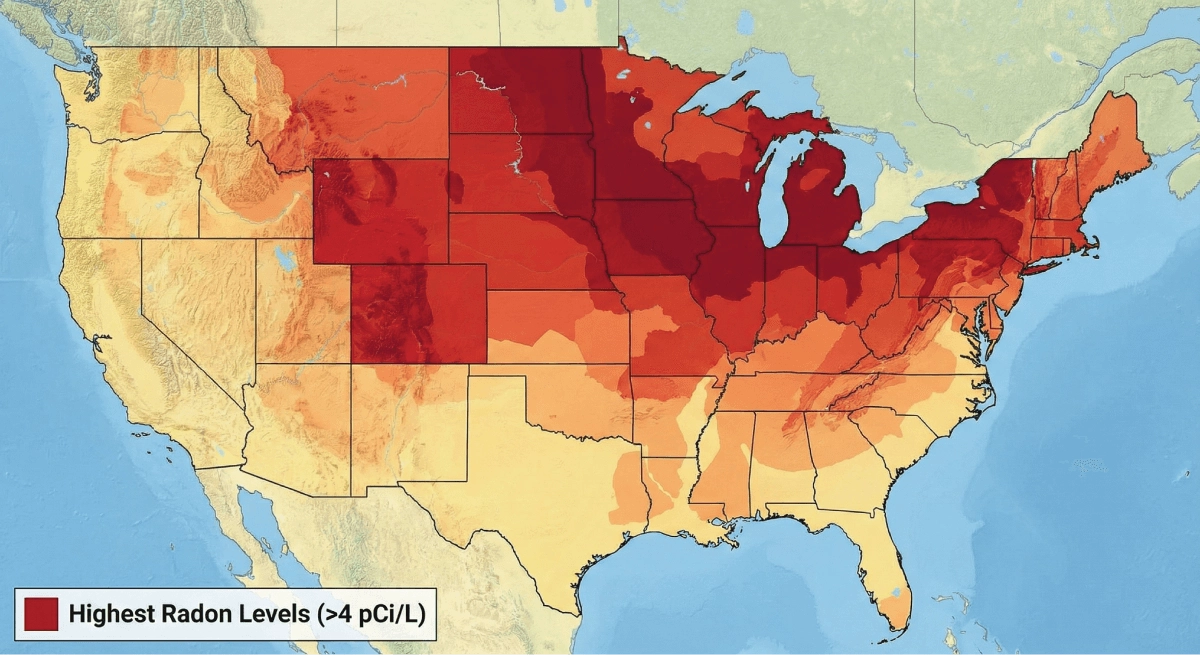 The reason our levels are so high starts deep underground in the soil. We sit right on top of the Uranium Belt which is full of decaying granite. That granite breaks down over millions of years and turns into a radioactive gas. This gas rises up through the dirt and looks for the easiest way to the surface. Your house acts like a giant chimney that sucks this gas right out of the ground. We call this the stack effect and it gets much worse in the winter.
Our cold winters make the problem dangerous for unsuspecting homeowners. When you run your heater it pulls warm air up to your second floor. This creates a vacuum in your basement or crawlspace that pulls gas in from the soil. I have seen tests in January read thirty percent higher than tests done in July. That is why I never trust a test result from the middle of summer. You need to know what the house does when the windows are shut tight.
Newer homes are actually often more dangerous than the drafty ones built in the 1970s. We build houses today to be incredibly tight to save money on energy bills. We wrap them in plastic and seal every single crack with heavy foam. This keeps your heat inside, but it also traps the radon gas inside with you. A drafty old Victorian house lets the gas escape through the leaky windows. Your energy-efficient new build holds it all in like a sealed Tupperware container.
The Passive System Lie in New Construction
Builders will tell you the home has a radon system, so you are safe. This is usually only half true, and it gives buyers a false sense of security. Most new homes in Colorado get what we call a passive radon loop. It is just a plastic pipe that runs from the gravel under the basement to the roof. There is no fan attached to it to actually pull the gas out. It relies on natural air pressure to move the gas up the pipe.
The problem is that natural pressure is rarely strong enough to do the job. I see passive systems fail radon tests almost as often as homes without systems. The pipe is there, but the gas still pushes through the cracks in the concrete floor. You need to be ready to finish the job that the builder started. Do not assume the pipe means the air is clean.
You will likely need to pay a pro to activate the system after you move in. This usually costs about $500 to $800. They go into your attic and cut that plastic pipe to install an electric fan. This fan runs continuously to create suction under your slab. You can look in the attic to see if there is a dummy outlet box near the pipe. That is where the fan plugs in when you finally decide to install it.
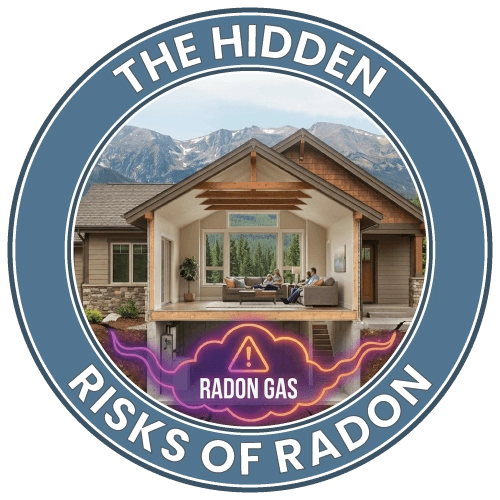
The Hidden Risks
 You might hear people worry that granite countertops emit radon gas. This is technically true, but it is almost never enough to hurt you. The amount of gas coming from a slab of stone is tiny compared to the soil. The dirt under your house is the enemy you need to watch. Do not let someone sell you an expensive seal for your counters. It is mostly a scam to scare you into spending money.
The real hidden danger is for people who live up in the mountains on a well. Radon can dissolve into the water and come out of your faucet when you shower. It creates a burst of gas right in your face while you are trapped in a small bathroom. The rule of thumb is that 10,000 picocuries in water equals 1 in the air. That sounds like a lot, but we see wells hit crazy high numbers in the foothills.
The risk with well water is not just breathing it in. You also risk stomach cancer from drinking that radioactive water every day. Fixing a well is much more expensive than fixing a basement air problem. You need a special machine that removes air from the water before it enters your pipes. These systems can cost $4,000 or more. Always test the water separately if the home is not on city utilities.
The Low Level Debate
The government set the safety limit at four picocuries per liter of air. They did not choose that number because it is perfectly safe. They chose it because it was the level they thought technology could reach back in the 1980s. The World Health Organization actually suggests a much lower limit of 2.7. There is no wall that stops the cancer risk once you get below four.
Living in a house with a level of 3.5 is not risk-free. Over twenty years, that exposure adds up to a huge dose of radiation for your lungs. It is roughly the same risk as smoking half a pack of cigarettes every single day. If you have kids in the house, you should think hard about that number. Their lungs are smaller, and they breathe faster than adults do.
I tell my clients to mitigate the house, even if it tests at 3. The cost of a fan is so small compared to the peace of mind. Why would you gamble with your health over a thousand dollars? If the level is higher than 2.7, you should fix it. You will sleep better knowing you did everything you could to keep the air clean.
The Shift to Real-Time Digital Monitoring
For decades, the standard way to check for radon was the "charcoal canister"—a small box you’d leave on the counter for 48 hours and then mail to a lab. While these are still used in real estate transactions for quick results, we are seeing a major shift toward continuous digital radon monitors for long-term home safety.
Long-Term Averages: Instead of a 2-day "snapshot," you get a rolling 365-day average, which is a much more accurate representation of your actual health risk.Instant Alerts: Many modern devices sync to your smartphone and will send a notification if levels spike above the 4.0 pCi/L threshold.Visual Indicators: Most units feature a simple "Traffic Light" system (Green, Yellow, Red) so you can check your air quality at a glance.
Pro Tip for Homeowners: Even if your home has a mitigation system installed, we recommend keeping a digital monitor in the basement. It’s the only way to know instantly if your mitigation fan has failed or if new cracks in the foundation are letting more gas into your living space.
Radon in the Real Estate Contract: Who Pays?
 In the Colorado Real Estate Contract, radon falls under the Inspection Objection period. Because radon is considered a health hazard, it is one of the most common items cited in an inspection objection. Here is how the process typically plays out in a Colorado Springs or Denver area transaction:
The "Action Level" Standard
Most local real estate agents use the 4.0 pCi/L threshold as the "trigger" for a mitigation request. If the test comes back at 4.0 or higher, the buyer typically asks the seller to install a mitigation system prior to closing.
Common Negotiation Outcomes:
- Seller Installs the System: This is the most common outcome. The seller hires a licensed mitigator (now required by Colorado law) to install a sub-slab depressurization system and provides the buyer with a receipt and a follow-up test showing the levels have dropped.
- The Closing Credit: In a fast-moving market, a seller might offer a credit (usually between $1,200 and $1,800) to the buyer at closing. This allows the buyer to choose their own contractor and have the system installed after they move in.
- "As-Is" Sales: In some cases, particularly with fixer-uppers or estate sales, the seller may refuse to mitigate. In this scenario, the buyer must decide if they are willing to take on the cost of the system themselves.
Pro Tip: If you are buying a New Construction home, check if the builder installed a "Passive System." These include the vent pipe but no fan. If your test comes back high, "activating" the system is as simple as having a licensed pro add the fan in the attic—a much cheaper fix than a full retrofit!
Conclusion
You do not need to panic if your dream home tests high for radon. It is a very fixable problem that we deal with every day. I have never told a client to walk away from a house just because of radon. You just need to know the numbers and have a plan to fix it. The house next door might test low and yours might test high. The only way to know the truth is to run the test yourself.