New - 15 Hours Ago


$675,000
Active
3
Beds
4
Baths
2122
Sqft
0.16
Acres
7754 Woodstock Ct, Castle Pines, CO 80108
MLS#: 2137039



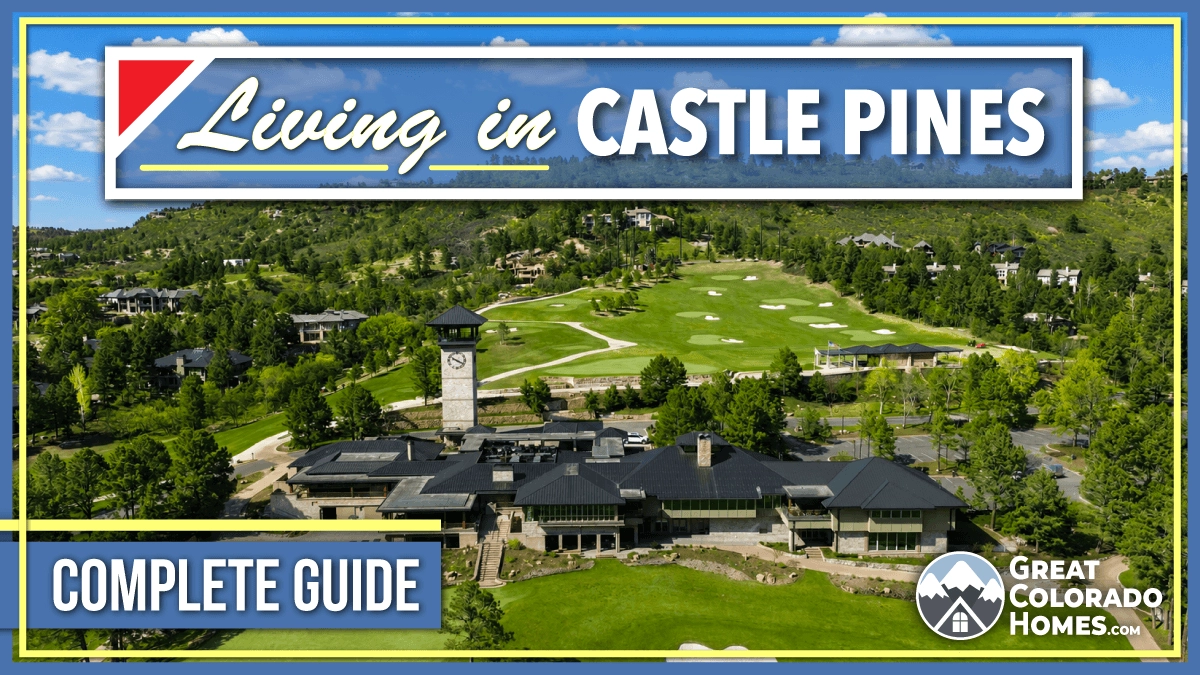
If you are moving to Castle Pines, expect an affluent, low-density Douglas County city set along I-25 between Highlands Ranch and Castle Rock. Buyers come here for ponderosa pines, larger lots, and Front Range views without giving up a practical commute to the Denver Tech Center. The tradeoff is straightforward. There is no real downtown, walkable nightlife is thin, and the entry price runs higher than in Parker or Highlands Ranch. This guide covers what we actually tell relocation buyers who narrow in on this corner of the metro.
 Castle Pines is a young city. It incorporated in 2008 and carved itself out of unincorporated Douglas County to keep its own character instead of being absorbed into Castle Rock's growth. The City of Castle Pines counts roughly 16,000 residents today. The boundaries have grown through annexation. Castle Valley joined in 2008, The Canyons in 2009, and Castle Pines Town Center in 2012.
The name trips up buyers. Castle Pines the city, Castle Pines Village the gated community, and unincorporated county parcels that carry a Castle Pines mailing address all share the 80108 ZIP code. They are not the same place. Governance, pricing, and amenities differ by section. The monthly cost of owning there does too.
When buyers tell me they want to look in Castle Pines, the first question I ask is which Castle Pines they mean. The gated Village, the new-construction Canyons, and established Castle Pines North carry very different price tags and very different rules. That single answer usually reroutes the whole search.
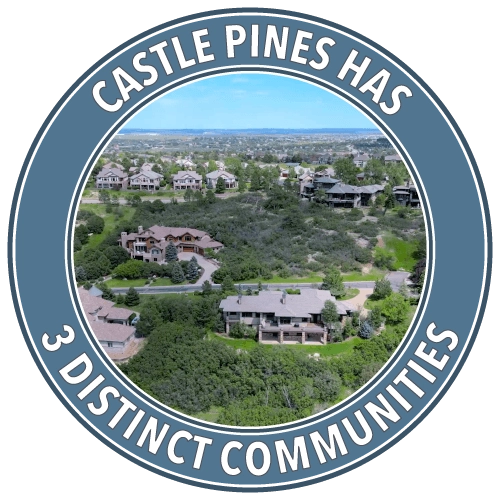 Castle Pines Village is the original and most exclusive section. The Village at Castle Pines is a private, gated community with 24-hour security and two private golf courses. Amenities include tennis, pools, and an extensive trail network. Homes here typically run from the $800,000s past $2 million. The carrying cost is the bigger story. Village HOA fees often land between $300 and $600 a month depending on the sub-association. That money covers gate security, road maintenance, and amenity upkeep. Buyers shopping this section should also browse gated-community homes in Castle Pines and luxury homes in Castle Pines.
The Canyons is the active new-construction story. The city annexed this 3,343-acre parcel in 2009, and multiple builders are still filling it in. Buyers find modern floor plans and a resort-style amenity center. Price points start lower than the Village, often in the low $600,000s. The Castle Pines new construction search is the best place to track what is actively building. The Exchange Coffee House and Visitor Center is a smart first stop for newcomers who want to tour models from the community's builders.
Castle Pines North is the value tier. These are established single-family homes from the 1990s and 2000s, generally in the $550,000 to $750,000 range, with strong school access and none of the Village's premium pricing. Some parcels here carry no HOA at all. The main Castle Pines homes search covers most of this tier.
Timber Canyon and Lagae Ranch run along the Lagae Road corridor. These are newer move-up and executive homes on larger lots with strong mountain views. The draw here is more space and a quieter setting close to I-25, without the interchange congestion. Buyers who want room to spread out sometimes cross-shop homes on acreage in Castle Pines.
One thing I notice when showing The Canyons versus Castle Pines North is how differently buyers react to the monthly bill. New construction looks great on a price-per-square-foot basis until you add the metro-district taxes. That is where established Castle Pines North suddenly looks more competitive.
This table sums up the four sections at a glance.
| Community | Typical price range | Monthly cost beyond the mortgage | Gated? | Best fit for |
|---|---|---|---|---|
| Castle Pines Village | $800K to $2M+ | HOA $300 to $600/mo plus club options | Yes, 24-hour security | Move-up and executive buyers wanting golf and privacy |
| The Canyons | Low $600Ks and up | Metro-district taxes plus HOA | No | New-construction buyers wanting modern plans |
| Castle Pines North | $550K to $750K | Some parcels carry no HOA | No | Value-tier buyers wanting established school access |
| Timber Canyon / Lagae Ranch | Move-up to executive | Varies by sub-community | No | Buyers wanting larger lots and mountain views |
Castle Pines carries a higher price floor than Parker or Highlands Ranch. Established homes in Castle Pines North generally sell in the $850,000 to $950,000 range, The Canyons starts in the low $700,000s, and Village estates climb well past $1.5 million.
The table below shows closed MLS comps over the trailing 90 days for each section.
| Community | Median sold price | Median days on market | List-to-sale ratio |
|---|---|---|---|
| Castle Pines North | $987,500 | 5 | 99.5% |
| The Canyons | $1,120,000 | 24 | 98.1% |
| Castle Pines Village | $1,710,000 | 38 | 95.5% |
Source: REcolorado MLS closed comps, trailing 90 days ending 7/21/26. Colorado is a non-disclosure state, so these figures reflect broker-reported MLS data rather than public sale records.
Because Colorado is a non-disclosure state, the sale prices you see on national portals are estimates, not records. We pull actual comps from the MLS. That matters more here than in most Denver suburbs, because the monthly cost of a Castle Pines home is rarely just the mortgage.
HOA dues, metro-district or special-district taxes, and sometimes club initiation fees stack on top of the payment. In the Village, HOA dues of $300 to $600 a month are normal. In The Canyons, a metro district can add a meaningful mill-levy cost that new-construction buyers do not always see coming. Transfer fees and initiation fees can apply in gated sections. We always walk buyers through the total monthly carrying cost, not just the list price, before they choose between Village and non-Village options.


 Castle Pines is located just off I-25 between the Castle Rock interchange and C-470. That north-south corridor is where the commute shines. The Denver Tech Center is roughly a 25 to 35 minute drive in normal traffic. Downtown Denver runs 40 to 50 minutes. Denver International Airport is about 40 minutes via the E-470 toll road, or a few minutes longer on the free C-470 and I-225 route. Check live conditions with CDOT before you plan a route.
The weakness is east-west. Castle Pines has limited cross-connectivity. Trips to Parker, Highlands Ranch, or the Aurora employment corridor take longer than the map distance suggests. If your daily commute runs east-west instead of north-south, drive the route at rush hour before you buy.
Public transit inside the city is limited. Regional bus and park-and-ride options are available in nearby Lone Tree and Parker through RTD. Most residents rely on a car, and most shopping runs into Castle Rock or Lone Tree.
I tell every relocation buyer to drive their commute at the hour they would actually leave. A Castle Pines address that looks 20 minutes from a workplace on paper can feel very different at 7:30 am on a Tuesday morning.
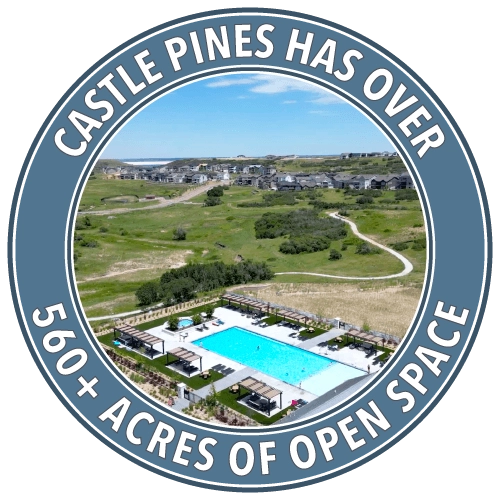 Open space is the point of Castle Pines. The city protects roughly 560 acres of open space and about 74 acres of parks inside a 9.55-square-mile footprint. The ponderosa pines that give the community its name are real, not imported landscaping, and the terrain rolls more than it does in denser suburbs to the north.
Daniels Park is the headline open space. It is part of the Denver Mountain Park System, holds a bison herd, and serves up some of the most dramatic Front Range views in the metro. Historic ranch buildings, hiking and biking trails, and climbing routes run through the park.
Rueter-Hess Reservoir is the nearby water option. It is located on Hess Road about a mile east of I-25 at the Castle Pines Parkway exit. The reservoir allows stand-up paddleboarding, kayaking, and catch-and-release fishing. A hiking trail climbs to a viewpoint above the water. No swimming is allowed, reservations are required, and dogs stay leashed on the trails. The Rueter-Hess Recreation Authority manages the rules.
Golf is a core part of the lifestyle. The Village holds two private clubs, the Country Club at Castle Pines and The Ridge, which has hosted PGA Tour events. The Ridge is a 27-hole public course that has drawn recognition from Golf Magazine, Golfweek, and Colorado Avid Golfer. Cherokee Castle and Ranch offers a unique destination, with a historic structure and events nearby.
We send a lot of dog-owning buyers toward the open-space corridors on the east side of the city. The trails around Daniels Park and the greenbelts leading toward Highlands Ranch are where most people get their daily miles.
This is not a walkable community in the traditional sense. The Town Center at Castle Pines and Village Square handle everyday retail and some dining. The heavier shopping runs through Castle Rock along Meadows Parkway, or north to Lone Tree and the Park Meadows area. Most residents treat the 5 to 10 minute drive to Castle Rock as the price for a quiet setting.
Healthcare is close. Sky Ridge Medical Center in Lone Tree is the major hospital for the south metro, with additional full-service hospital services in Castle Rock. Urgent care and specialty clinics are available along the entire I-25 corridor. The Douglas County Libraries branch in Castle Pines is a useful community anchor for families.
When buyers ask me what Castle Pines is missing, I usually say a true downtown. The city has traded that for low density and quiet streets. Most people who move here are happy with that trade once they settle in.
The setting brings wildlife. Mule deer are a daily sight. Bobcats, mountain lions, and even bears pass through the open-space corridors. Colorado Parks and Wildlife is the source for living-with-wildlife guidance, and newcomers should read up before assuming a backyard fence keeps animals out.
The weather is one of the strongest selling points. Castle Pines averages nearly 300 sunny days a year, with four distinct seasons and low humidity. Summer heat is dry. A 90-degree day feels different the moment you step into shade, and winters bring cold snaps and snow without the heavy accumulation the mountains get.
Snow removal is a neighborhood-by-neighborhood question. City-maintained roads clear on one schedule, and private roads or HOA-maintained streets clear on another. Read the HOA documents before you buy so you know who is responsible for the road, driveway, and sidewalk.
Castle Pines is one option in a crowded south-metro market. Here is how it lines up against the communities buyers usually cross-shop.
We run this comparison with almost every relocation buyer. Most people who choose Castle Pines over Highlands Ranch are trading retail convenience for lower density and a ponderosa-pine setting.
Out-of-state buyers are drawn to Castle Pines for a few predictable reasons. The Denver Tech Center commute, the Douglas County schools, and the airport access do most of the work. Denver International Airport is about 40 minutes away via the E-470 toll road. The elevation is above 6,000 feet, so plan on a few days of adjustment if you are coming from sea level. For the statewide picture, our moving to Colorado guide covers licensing, registration, and what to expect across the Front Range.
No. Castle Pines is the incorporated city, formed in 2008. Castle Pines Village is a separate gated community inside the broader Castle Pines area. It has its own governance, golf courses, and higher HOA costs. They share the 80108 ZIP code but are different places to buy.
The Denver Tech Center is roughly a 25 to 35 minute drive from Castle Pines in normal traffic via I-25. Downtown Denver is about 40 to 50 minutes away. East-west commutes to Parker or Aurora take longer because cross-connectivity is limited.
Castle Pines feeds into the Douglas County School District. Most addresses are typically zoned for Buffalo Ridge Elementary, Rocky Heights Middle School, and Rock Canyon High School. Confirm current boundaries for a specific address directly with the district before you buy.
Castle Pines carries a higher price floor than Parker or Highlands Ranch. Established Castle Pines North homes generally trade in the $550,000 to $750,000 range, The Canyons starts in the low $600,000s, and Village estates climb past $1 million. Colorado is a non-disclosure state, so we pull real comps from the MLS rather than portal estimates.
Castle Pines fits buyers who want a quiet, upscale suburban setting with trails and golf, plus a practical south-metro commute. It tends to work well for:
It is a harder fit if walkable restaurants are a priority, if the budget falls under $500,000, or if your daily commute runs east-west. For the right buyer, Castle Pines is genuinely difficult to beat.
We help relocation buyers compare the Village, The Canyons, and Castle Pines North on total monthly cost. The goal is what you will actually pay each month, not just the list price. Browse Castle Pines homes for sale, or talk to a buyer's agent about timing your move. You can reach us at 720-706-6333 and learn more about our team here.